Useful AI is here, and the bills prove it
What US$171,000 a week on Claude Code really signals.

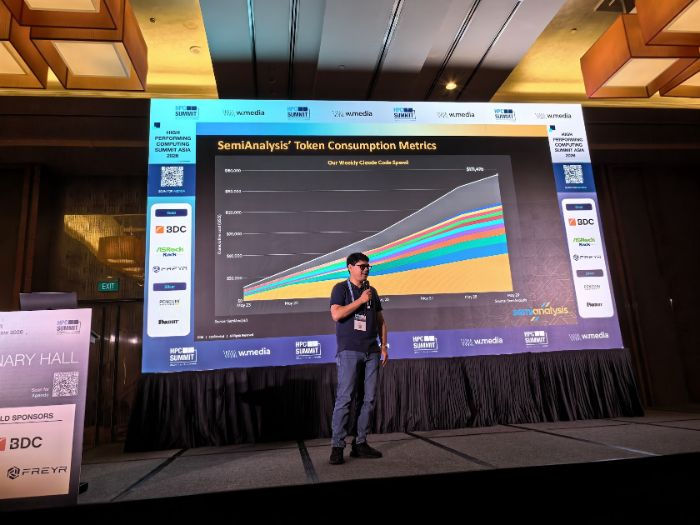
Useful AI is here, and the bills prove it. SemiAnalysis spends US$171,000 a week on Claude Code. GMI Cloud now handles 200 billion tokens a day.
At the w.media HPC Summit Southeast Asia 2026, speakers discussed the rise of AI, the practicalities of deploying GPUs, the economics holding it all up, and the strain building underneath. Here are some observations I made today.
Nvidia's role in AI adoption
According to SemiAnalysis' Daniel Nishball, who opened the day's session, his firm spends US$171,000 a week on Claude Code, or roughly US$10 million annualised. That is a striking number for a research outfit, and a useful proxy for how far working AI has come.
He also spoke about Nvidia's role in bootstrapping AI adoption. The company is doing this in two main ways: by directly leasing data centre capacity, and by signing offtake deals with Neoclouds. According to Dan, Nvidia is increasingly doing both overseas and with smaller, more upstart Neoclouds specifically, the better to seed the ecosystem.
These Cloud Service Agreements, detailed in Nvidia's financial filings as obligations to cloud services, effectively make it the central bank of AI.
The era of useful AI
I was sceptical 12 months ago about whether AI adoption would actually increase. But the arrival of useful AI in the last six months changed my mind, as developers and users started getting meaningful work done with it.
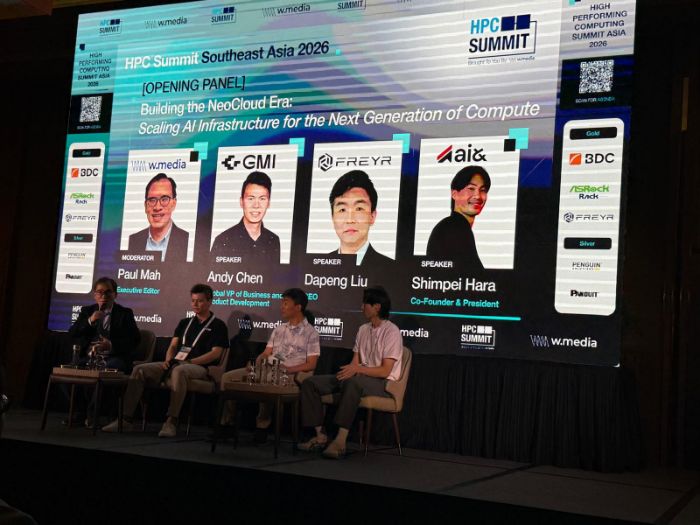
GMI Cloud's Andy Chen confirmed this when he shared how daily consumption jumped from one to two million tokens per day six months ago to more than 200 billion today, a 100,000x increase. What's more, GMI Cloud is projecting this to reach a trillion tokens a day by the end of this year. In his words, the demand for AI is real.
The end of the all-purpose data centre
For Freyr Technology's Dapeng Liu, the old model of data centres serving a diversified customer base, spanning enterprise and AI users alike, no longer makes sense. Specialisation is now necessary, he thinks, and the days of operators doing both general compute and AI may be coming to an end.
Don't forget the CPUs, notes Shimpei Hara of AI&. He points to agentic workloads from the likes of Open Claw and the rise of loop engineering. As autonomous agents that run continuously surge, expect CPU usage to spike alongside GPU usage. If left ignored, the CPU could well become an inadvertent bottleneck.
In a parallel event, the inaugural Data Center Investment Summit (DCIS) Asia drew more than 100 attendees from the finance and data centre space to its ticketed conference. If the bills prove that useful AI has arrived, the question now is who gets to build, and pay, for what comes next.