The UPS that doesn't use batteries at all
DRUPS relies on kinetic energy, and it still has its place.

Did you know there are power backup systems that don't use chemical batteries at all? And that they're well suited to high-load equipment such as data centre cooling systems?
As I mentioned yesterday, data centres rely on UPS systems for power protection. Most use chemical batteries. DRUPS doesn't have any onboard, and it has been deployed in data centres for decades.
So how does it work, and what are its strengths and weaknesses?
Powering data centres
Data centres need power, and they need it supplied reliably around the clock. In practice, that means Uninterruptible Power Supply (UPS) systems.
Broadly, a UPS sits between incoming mains power and the servers that need to stay up. Should the grid stutter or a breaker trip, it kicks in and keeps the power flowing.
They're a familiar sight in many facilities, where banks of lead-acid or lithium-ion UPS systems are commonly deployed. These furnish enough power for a short period, measured in minutes, for on-site diesel generators to spin up properly.
A different kind of UPS
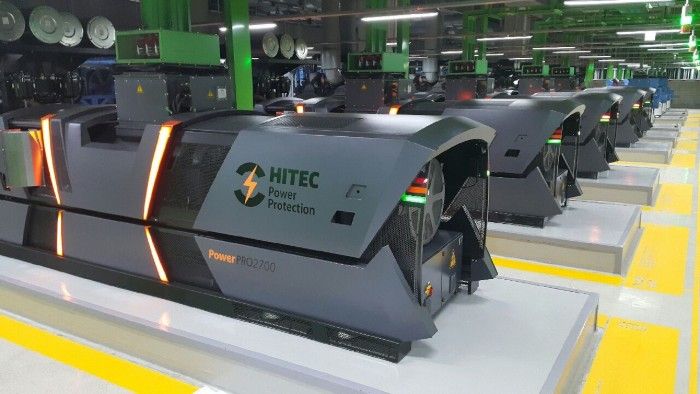
Apart from these "static" battery systems, there is another type of UPS entirely. Known as Dynamic Rotary UPS, or DRUPS, it relies on kinetic energy for up to a minute before the diesel generators take over fully.
The design pairs a built-in kinetic energy module, which keeps spinning on inertia when power goes out, with a diesel generator. Together they deliver power conditioning, the ability to function as a UPS when power fails, and sustained power generation until the mains return.
Should the mains drop, the kinetic energy module is what ensures the seamless transition from mains to generator power.
The real story
DRUPS offers several advantages over static chemical batteries. It takes up less floor space, allows greater flexibility in placement, and is well suited to large IT and critical cooling loads.
I remember visiting data centres a decade ago and seeing DRUPS systems in almost every one of them. They're a less common sight today.
Part of the reason is reputational. Several high-profile outages linked to DRUPS took a toll, and earlier systems could be challenging to maintain. Lithium-ion batteries have since eroded some of the footprint advantage that DRUPS once held.
However, the sheer maturity of the technology means the issues of the past have long been addressed. Modern DRUPS brings placement flexibility from its reduced fire risk compared with lithium-ion, a long service life of up to two decades, and no chemical waste to discard at end of life.
To my knowledge, DRUPS continues to be favoured by some operators for its ability to support continuous loads such as mechanical cooling plants, and for a significantly lower total cost of ownership (TCO) over the long term.
Which raises a question worth putting to the industry: which data centres are still running DRUPS today, and why don't we hear more about them?