LinkedIn and Substack have declared war on AI slop
Two platforms now hand readers a button to fight back.


Sweet. Polished. Empty. LinkedIn and Substack have started a war against AI slop, and it's worth asking why two platforms that live on volume have decided enough is enough.
In case you didn't notice, LinkedIn now has a button for you to report AI slop. Substack will run an AI detector check for you. Clearly, people have no love for AI-generated content.
So here's the real problem with AI, and how you can build your brand without losing your voice to it.
The problem with slop
When I started speaking against AI slop in 2024, it ruffled some feathers. It took a while to figure out why: everyone was using AI differently, and some had incorrectly thought I was criticising them for using it at all.
Far from it. I use AI every day to code my various apps, analyse ideas or find an elusive word, edit and review my writing, work through transcripts, and review presentations, among other things. What I don't like is AI slop.
Why no love for AI
I've always sought to express my ideas clearly. Economy of words and getting to the point matter to me. The problem is how AI makes it possible to produce copious, coherent-sounding text with zero finesse.
Everyone, including those with half-formed ideas or who haven't done the hard work of thinking, can now present persuasive prose that is ultimately fluff.
More than once I've come across content that reads well but is much longer than it needs to be, has an absence of unique or sharp ideas, and meanders through circular arguments.
Worse, this sludge-like content shifts the cognitive burden onto the reader. I now have to work much harder to understand what the author is trying to convey. Imagine reading an entire verbose 2,000-word piece before realising it could probably have been expressed in 50 words. I hated such experiences.
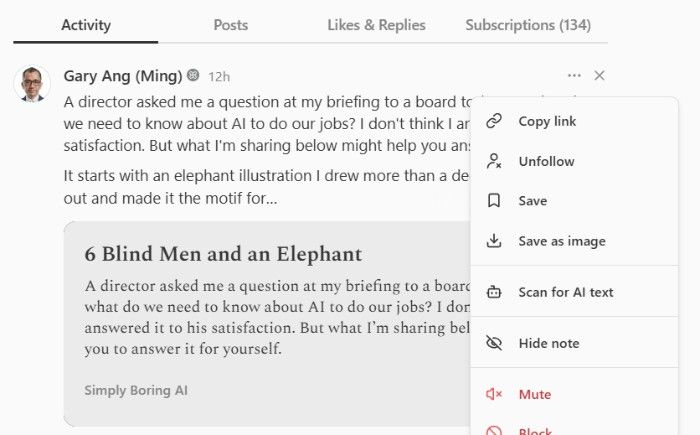
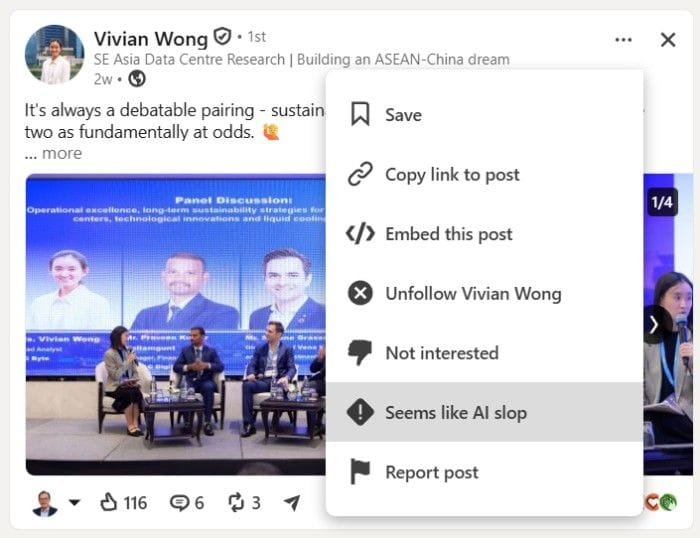
Screenshot: A LinkedIn post by Vivian Wong and Substack post by Gary Ang, chosen because you'll surely know they do not do AI slop.
It's your ideas
Here's the thing. Some readers can't tell AI use apart. But those who can? They might smile and nod. And then they'll steer clear of you in the future.
As someone who uses AI a lot, the tell-tale signs are often clear as day to me. And mind you, unless you know what you're doing, even "light" edits can quickly gum up a piece.
Maybe it's time to put AI aside for a moment. Write to express your ideas and sharpen your thinking, not to churn out copy for the sake of driving engagement on social media.
Do that and you'll develop a distinctive voice and a brand that is actually yours. Readers will learn to trust you. And your ideas will have the room they need to do their work.
So the question worth sitting with is a simple one: when you next open a blank page, are you writing to think, or writing to publish?