What it takes to support Nvidia's Vera Rubin GPU
The global average rack power is 8kW. Rubin Ultra will need 600kW.

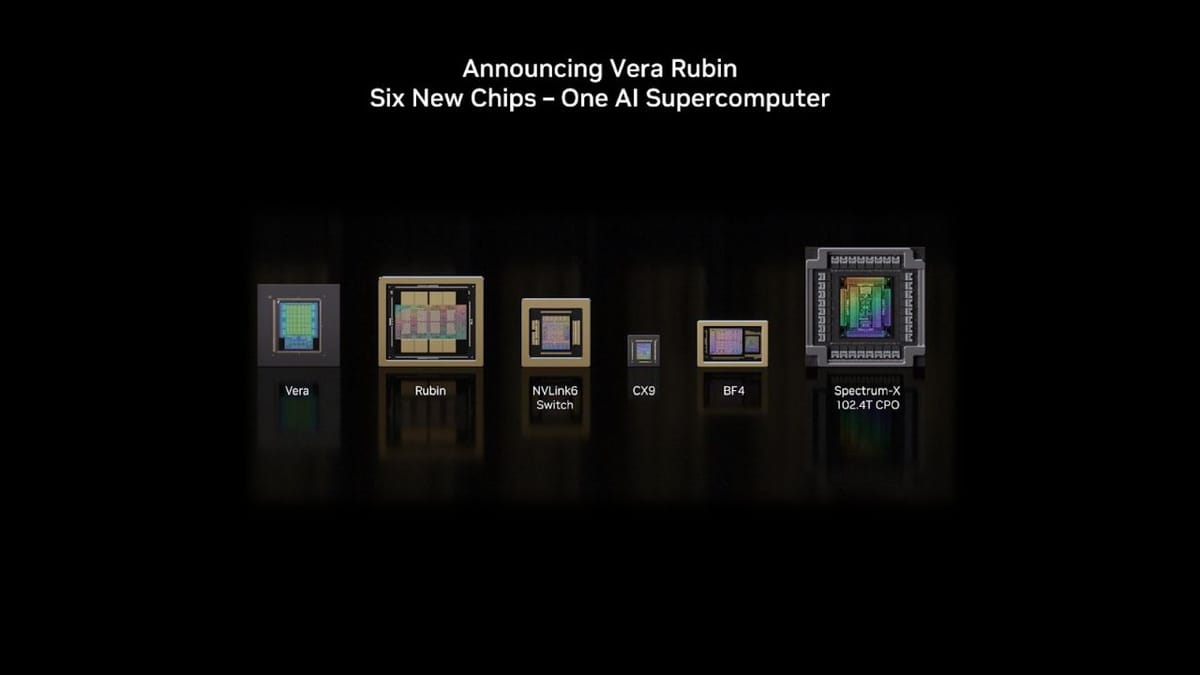
What would it take to support Nvidia's upcoming Vera Rubin GPU? Well, it'll take a complete redesign of the data hall, if not the entire data centre.
Vera Rubin GPU
The Vera Rubin platform was announced by Nvidia at GTC 2025, where details of the new family of GPUs that will replace the Blackwell family were first shared with timelines. Vera Rubin is expected to be available in 2026, while Rubin Ultra is 2027.
Power requirements will differ depending on the exact GPU: 120-130kW per rack for the Vera Rubin NVL72, 190kW for the NVL144, 370kW for the NVL144 CPX, and 600kW for the Rubin Ultra.
The strategy is clear: to ramp power up over 24 months, starting with the Vera Rubin NVL72 with Blackwell-level 130kW per rack power requirement.
The end goal? 600kW. For context, the global average data centre rack power is just 8kW in 2024, according to Uptime Institute. Supporting this insane capacity calls for drastic changes in data centre design. Here are three of them.
DC power
Nvidia's reference design for Rubin Ultra converts medium-voltage AC at the facility level to 800 VDC. This is then distributed via DC busways directly to racks where it is stepped down to 12 VDC for use.
Beyond a redesign of the power infrastructure for significantly improved efficiency, this also removes rack-level AC components such as traditional PDUs (power distribution units) and PSUs (power supply units).
Cooling capacity
At 600kW racks in its eventual iteration, cooling the Rubin Ultra rack will take a new generation of CDUs. While CDUs of 1-3MW already exist, the idea is for each CDU to distribute coolant across multiple compute racks.
At 600kW per rack, this means far more powerful CDUs. Put it this way: many of the systems required to support the Rubin Ultra either don't exist yet or have not been deployed at scale previously.
Rack-adjacent systems
Nvidia's design assumes a sidecar rack to handle the power and cooling required. This reinforces the trend of rack-adjacent mechanical and electrical systems becoming a permanent fixture.
This is a big change, as these systems were previously sited outside the data hall.
How is Vera Rubin coming along? At CES earlier this month, Nvidia CEO Jensen Huang said that the chip is on track and in full production.
Expect to see them in a data centre soon.