Can seawater keep data centres cool?
What leading experts shared at a Grundfos panel discussion.


Can seawater be used to keep data centres cool? Here's what I shared at a panel discussion this morning, and what I learned from leading experts in the field.
I was invited by Grundfos to moderate a panel discussion with Peter Lundberg, Md Raisul Islam, and Tay Leng Chua on the topic. It was an incredibly rich conversation, and one I'm still unpacking.
A changing landscape
Here's what I shared to kick off the session. The data centre industry sits at a pivotal moment in time. Never has demand for digital infrastructure grown so sharply, or changes within the data centre happened so quickly.
But dark clouds have appeared on the horizon. The first is tightening regulations on resource use. The second is growing negative sentiment towards data centres.
There is no doubt that the region needs more data centres, even without taking AI into consideration. So how can the industry tackle resource use and sustainability concerns? Seawater cooling could potentially address the resource use challenge, and assuage community concerns over insufficient water.
Here are two things I learned from the conversation.
Proven, but unforgiving
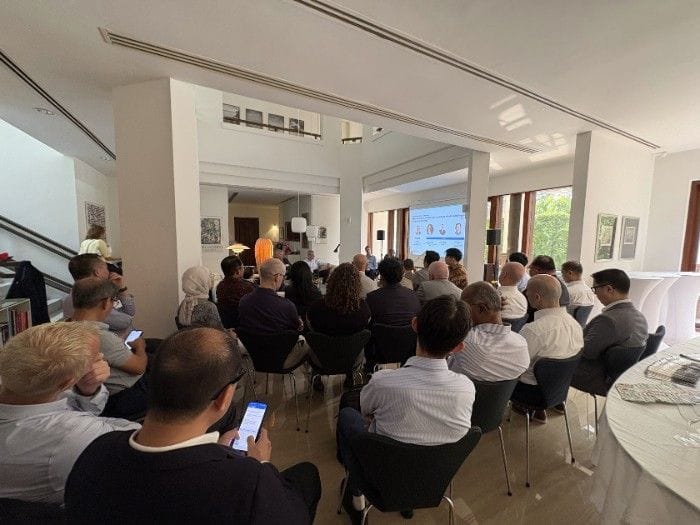
Photo: Chiew Ying (CY)
Seawater cooling has been in use for some time now, including in large-scale deployments around the world. In fact, Singapore's Changi Naval Base has a seawater cooling system that was operational for more than two decades.
The devil is in the details, though. Seawater cooling is fraught with design traps that have resulted in plants failing, or even being shut down entirely.
For instance, the materials used for pipes must be capable of resisting highly corrosive seawater. On top of that, seawater is unique in its biofouling properties. Fail to tackle it properly, and one can expect to see barnacles, tube worms, mussels, and other shellfish growing on various surfaces before long. We were shown photos, and they are not pretty.
No silver bullet
When discussing this topic, we are almost always referring to indirect seawater cooling. This essentially uses seawater drawn in to cool a second, sealed loop that goes into the data centre.
Seawater cooling could allow data centres to do away with cooling systems entirely. But it is no silver bullet, and its ultimate utility depends on workloads and objectives.
Does it make sense for an individual data centre operator to build its own seawater cooling plant? The panellists suggested that a district cooling deployment could offer greater economy of scale, spreading the cost and complexity across multiple users rather than leaving one operator to shoulder it alone.
Which leaves the question I'd put to you: will seawater cooling work where you live?