AMD shows off Instinct MI455X GPU on stage
Doubles down on going open with Helios platform for next-gen AI.

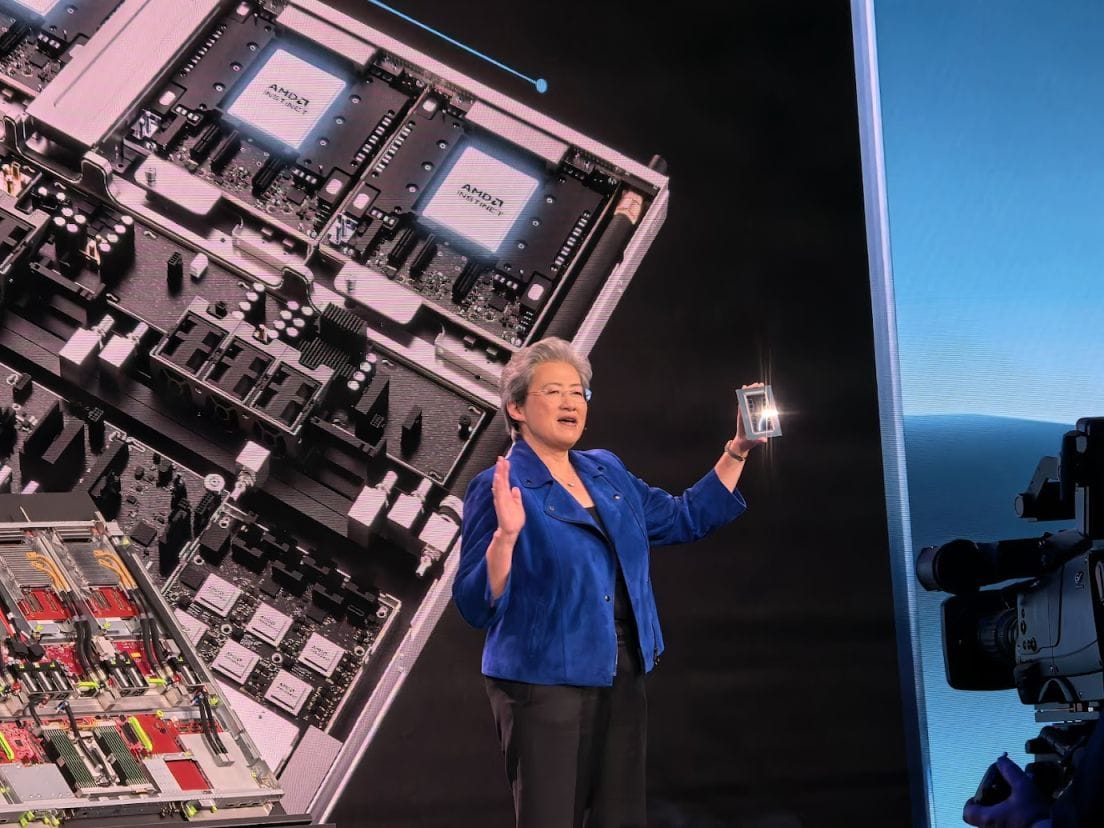
"You ain't seen nothing yet," said AMD CEO Lisa Su at her CES 2026 keynote today, as AMD doubled down on going open with its Helios platform for next-gen AI.
AI adoption has soared from a million to a billion active users. And as AI becomes indispensable, usage could well swell to over 5 billion active users, she noted. In short, we will need more AI data centres than ever.
Open ecosystem
Su started by talking about AMD's Helios open rack architecture, first announced in October 2025 at the OCP Global Summit in San Jose.
The idea is to build the capabilities for Yotta-scale AI data centres with leading GPUs, an open rack architecture, scalable AI with an open fabric for networking, rack-scale efficiency and serviceability, and turnkey solutions through partners.
"We believe an open ecosystem is essential to the future of AI. Time and time again, we've seen that innovation actually gets faster when the industry comes together and aligns around an open infrastructure and shared technology standards."
AMD is the only company delivering openness across the full stack, she says: hardware, software, and solutions ecosystem.
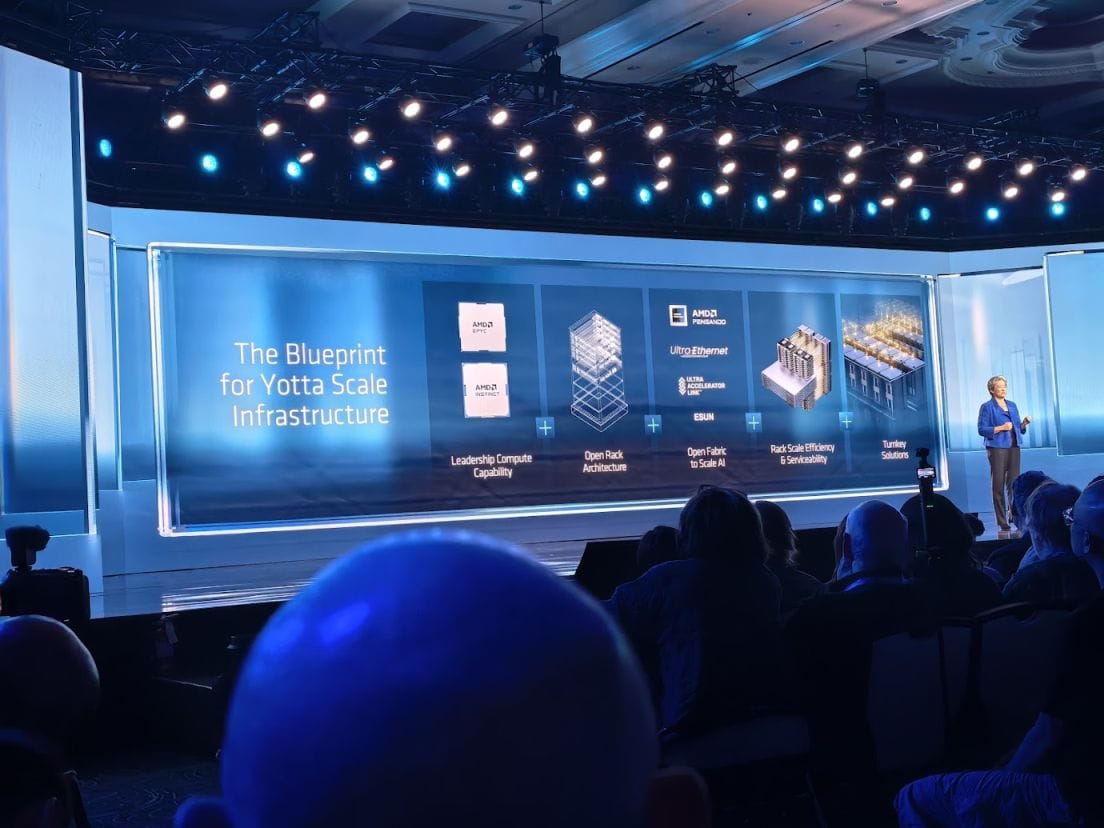
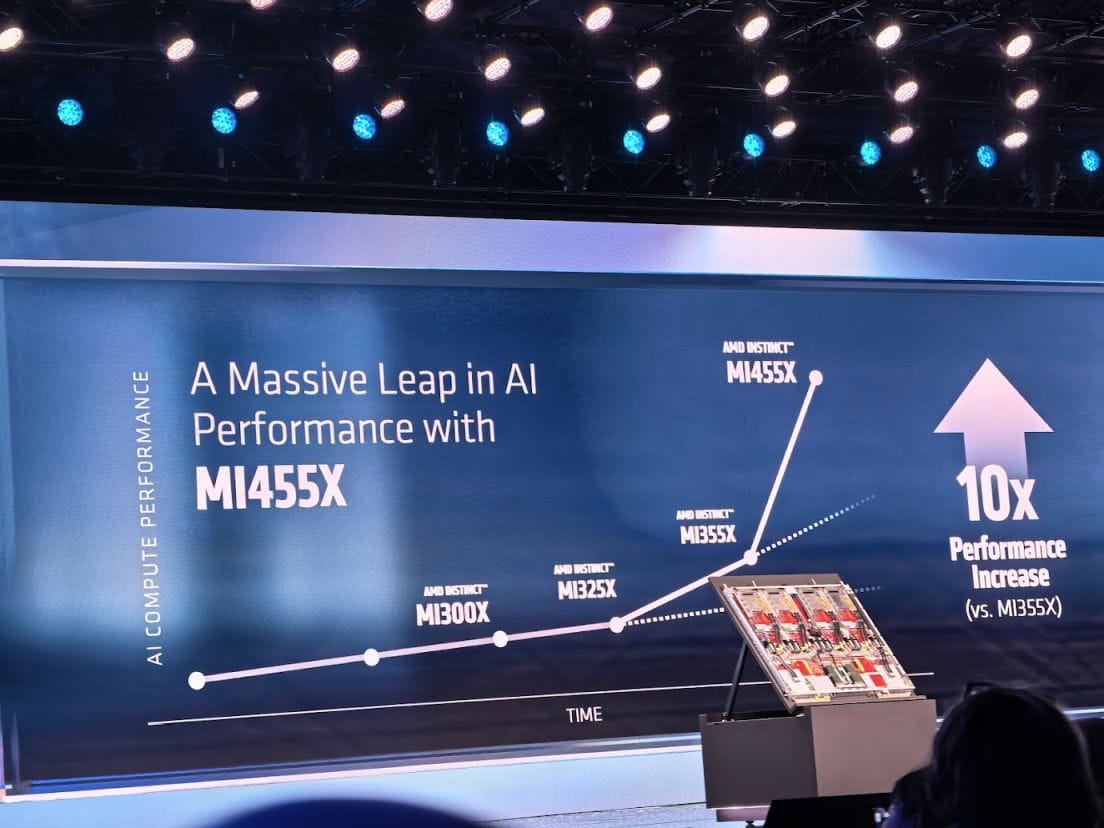
Photo Credit: Paul Mah
Upcoming GPUs
Su showed off the MI455X GPU on stage for the first time, which comes with 320 billion transistors, 3D chip stacking tech, and a whopping 432GB of HBM4 memory. As a comparison, Nvidia's initial Vera Rubin GPU will only come with 288GB of HBM4 memory.
Other GPUs in the family include the MI440X, an 8-GPU solution for enterprise AI training, fine-tuning, and inference, and the MI430X, a GPU solution for sovereign AI, HPC, and hybrid computing.
Su also disclosed the MI500 series, which she says will launch in 2027 and offers a "1,000x" increase in performance compared to the MI300X. The MI300 series was first launched in 2023. The MI500 will be manufactured with 2nm process technology and move on to use the upcoming HBM4E memory.
What next
One thing that caught my attention was how the MI455X, which will be paired with the upcoming EPYC Venice CPU, will use direct-to-chip liquid cooling even for memory. For AI data centres at least, the days of air-cooling appear to be numbered.
Finally, going by AMD's own performance chart, AI performance isn't growing linearly but rising sharply. To me, this means new data centre designs will be needed.
Check out Data centres in 2026: Where things are heading on Substack about where I see data centres heading in 2026.